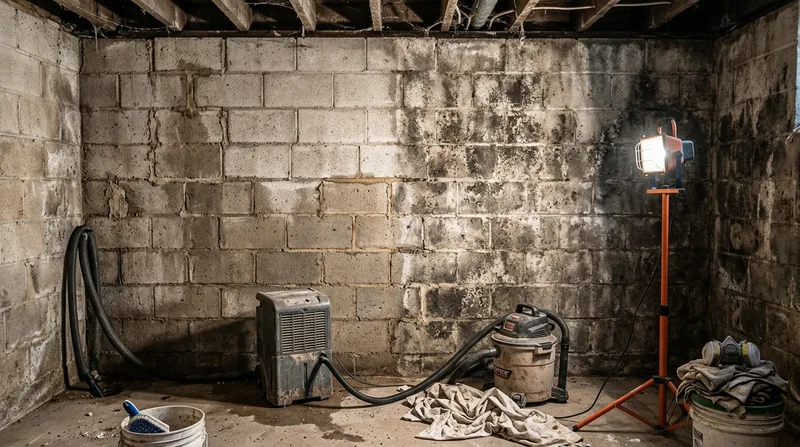


Basement Mold Remediation in Saginaw
Saginaw sits on a flat lake plain of heavy glacial clay that holds water near the surface and pushes it through every footing joint it can find. That means Basement Mold Remediation in Saginaw almost never starts with a spray bottle. It starts with finding where the moisture is coming from. In the 1890s to 1920s wood-frame houses on the Old Westside and near the river, fieldstone and brick foundations weep after every March snowmelt. In the 1920s to 1950s bungalows of Midtown and the Eastside, old clay drain tile clogs and block walls stay damp year-round. We remove the mold, treat the affected surfaces, and fix the moisture source so it does not come back. If you already know water is entering, start with basement waterproofing and we will pair it with remediation.
Why Basement Mold Grows So Fast in Saginaw's Clay Soil
The Saginaw Valley drains slowly. Glacial clay and clay loam keep water near the surface, and the Saginaw and Shiawassee rivers running high in spring press that water against basement walls. Freeze-thaw cycles open old mortar joints, and each cycle lets in a little more. Mold needs only damp building materials and still air, so a block wall that reads 70 percent relative humidity in July is enough to start it.
- Hydrostatic pressure pushes water through footing joints and block cores after heavy rain.
- Old clay drain tile in Midtown and Eastside bungalows silts up and stops moving water away.
- Sump pump failure during a March thaw leaves the basin full and the floor wet.
- Downspouts that dump next to the foundation recharge the soil right at the wall.
- Efflorescence and musty basement smell are the first visible and smellable signs.
Each of these is a moisture path, and each one has a specific fix before remediation can hold.
Key info: A 1954 ranch off State Street in Saginaw had mold on the lower two block courses and a musty smell in the finished room. The cause was a failed sump pump and a discharge line that dumped against the wall. We replaced the pump, extended the discharge, and remediated the wall. No mold returned the following spring.
For official guidance on moisture and mold in buildings, the U.S. EPA publishes plain-language resources at epa.gov/mold.
How We Run Basement Mold Remediation in Saginaw
We work in a fixed order because remediation before the moisture fix is wasted money. First we diagnose: moisture meter readings on walls and framing, a musty smell walkthrough, and a look at the drain tile, sump basin, and grading. Then we contain and remove. Then we correct the water path. Skipping the last step is why mold comes back in the same corner every spring.
- We inspect the basement and identify every moisture source, from footing joints to a dead sump pump.
- We set up containment with poly sheeting and negative air so spores do not spread to the rest of the house.
- We remove mold-damaged drywall, insulation, and wood that cannot be cleaned.
- We treat affected surfaces with an approved antimicrobial and HEPA-vacuum the space.
- We correct the water path with drainage, sealing, or a sump pump installation as the inspection dictates.
- We verify dryness with meter readings before we close the job.
You get a written scope that names the moisture source, not just the mold.
Key info: In a 1921 frame house near the river in Saginaw, the musty smell traced to a clogged clay drain tile under the floor, not to the wall itself. Cleaning and repairing the tile and adding an interior perimeter drain solved the moisture. Remediation then held through two spring thaws.
If the inspection points to a wet floor rather than a wet wall, the right next step is an interior drain tile system.
Remediation Approaches We Use in Saginaw Basements
Not every mold job is the same, and the approach depends on the material affected and the moisture source behind it. Here is how we match method to condition in Saginaw's older housing stock.
| Approach | Description | Best for |
|---|---|---|
| Surface treatment and HEPA cleaning | Antimicrobial treatment and HEPA vacuuming of block, concrete, and framing that is structurally sound. | Light surface mold on block walls with a known, fixable moisture source. |
| Containment and material removal | Poly containment, negative air, and removal of mold-damaged drywall, insulation, and wood. | Finished basements in 1950s and 1960s ranches with mold behind paneling or drywall. |
| Moisture correction with drainage | Interior perimeter drain, drain tile repair, or sump replacement paired with remediation. | Hydrostatic pressure and wet floors after rain, common on the Old Westside. |
| Sealing and vapor control | Basement wall sealing and a vapor barrier to cut the moisture vapor feeding surface mold. | Damp block walls that stay humid even when no standing water appears. |
| Dehumidification and verification | Drying, dehumidification, and meter verification before the job is closed out. | Every remediation, to confirm the basement reads dry before we leave. |
Basement Mold Remediation Cost in Saginaw: What to Expect
Basement mold remediation in Saginaw starts at From $1,500 for a contained single-area job with surface treatment. That figure covers containment, removal of affected materials in a limited area, treatment, and drying verification. The price moves up with square footage affected, whether finished materials have to come out, and whether a drainage correction is needed at the same time.
- The size of the affected area is the biggest single cost driver, since containment and removal scale with it.
- Finished basements cost more because drywall, insulation, and trim often cannot be cleaned and must be replaced.
- The moisture source matters: a failed sump pump is a smaller fix than a clogged drain tile under a slab.
- Access matters in Old Westside and Midtown houses, where narrow stairs and low ceilings slow the work.
- Emergency calls after a spring thaw cost more than scheduled work.
Get two or three estimates and compare scope, not just the number. Our full breakdown is on the pricing page.
Basement Mold Remediation Near Me: How to Vet a Contractor Near Saginaw
Anyone can rent a sprayer, so the vetting matters. Ask for the license and insurance certificate, and confirm the policy covers mold remediation work specifically, not just general contracting. Ask how they will find the moisture source, because a contractor who only treats surfaces will be back next spring. Ask for references from Saginaw, Bay City, or Midland jobs and call them.
- Confirm the company is licensed and insured and ask to see the certificate.
- Get multiple written estimates with the moisture source named in each scope.
- Check references from similar housing stock, especially older block and fieldstone basements.
- Ask whether structural or drainage work needs a permit from the local building department, since rules vary by jurisdiction.
- Get the warranty terms in writing and confirm they are transferable.
If a quote is far below the others and skips the moisture diagnosis, walk away. Reach us through the contact page to schedule a free basement inspection.
Basement Mold Remediation in Saginaw: Pricing Guide
| Service | Price | Details |
|---|---|---|
| Single-area surface remediation | Starting at $1,500 | Containment, surface treatment, HEPA cleaning, and drying verification for a limited affected area. |
| Finished basement remediation | Starting at $3,200 | Removal of mold-damaged drywall, insulation, and trim, plus containment and treatment. |
| Remediation with drainage correction | Starting at $4,800 | Remediation paired with interior drain tile, sump work, or crack repair so moisture stays out. |
| Complex or large-scale job | On estimate | Full-basement contamination or structural damage needs an on-site look before a number is given. |
| Travel | Included | In Saginaw and surrounding areas, no separate call-out or mileage fee. |
| Estimate | Free | Response within 24h at (989) 341-8992, no obligation to book. |
Indicative pricing, the exact cost depends on square footage, finish, and site access. Free personalized estimate within 24h at (989) 341-8992.


